
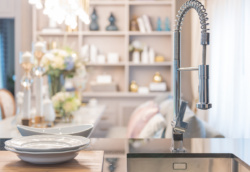
Did you know that most Americans spend more time in the kitchen than any other room in the house? The kitchen is the heart of the home, the command center for your family. It’s no wonder so many of us enjoy adding features and touches that bring both form and function to the space.
When buying a kitchen faucet, the options can be overwhelming. Hundreds of styles, finishes, and feature combinations across many brands can make a simple purchase feel like a research project. Fortunately, narrowing it down is easier once you know what to evaluate. Whether you’re remodeling your kitchen or just replacing an old faucet, this guide shows you how to choose a faucet that fits your sink, kitchen, and cooking style.
What Goes Into Buying a Kitchen Faucet
A few key factors should guide your decision before you ever start browsing styles. Confirm these first to avoid backtracking later.
Your Current Kitchen Layout
Unless you’re replacing your countertops as part of a larger remodel, the faucet you choose will depend on what’s already in place. Most countertops have one to four pre-drilled holes, and that determines which configurations are available to you.
- 1 hole fits a single-handle faucet without a side sprayer
- 2 holes fit a single-handle faucet with a separate side sprayer
- 3 holes fit a two-handle faucet or a single-handle with a side sprayer and soap dispenser
- 4 holes fit a two-handle faucet with a side sprayer and soap dispenser
If you’re starting fresh and can choose your own configuration, make sure your design team knows your faucet selection before the countertops are templated.
Faucet Finishes and Styles
Faucets come in a wide range of finishes, and the right choice depends as much on your other hardware as it does on personal taste. Popular options include:
- brushed nickel, which is warm, versatile, and hides water spots well.
- matte black, which makes a strong modern statement and pairs well with dark hardware.
- polished chrome, which is a classic that works in nearly any kitchen.
- oil-rubbed bronze, which is rich and traditional and pairs well with warmer cabinetry tones.
- stainless steel, which is casual and practical option that blends with stainless appliances.
While thinking about finishes, it is worth keeping in mind that the faucet finish should match at least one other element in the kitchen. Cabinet hardware, light fixtures, and appliance handles are the most natural choices. The faucet doesn’t need to match everything, but repeating a finish two or three times creates a cohesive look throughout the space.
If your faucet choice is part of a bigger kitchen renovation, coordinate your finish selection early. It is easier to align hardware decisions at the planning stage than to reverse-engineer a cohesive look at the end.
Kitchen Faucet Features Worth Thinking About
What features matter for the way you actually use your kitchen? A few worth considering before you commit to a model.
Sprayer Type
There are three main types of sprayers. Pull-down and pull-out faucets have integrated sprayers built into the head. A separate side sprayer is another option but requires an additional hole in your countertop layout.
Touch Activation
Touch-activated faucets are increasingly popular in busy kitchens. Hands-free water flow is a genuine convenience when you’re handling raw meat or moving something hot from the stove, and the technology has become much more reliable in recent years.
Flow Rate
Flow rate is worth considering even if it is not the most exciting spec. Standard faucets run around 2.2 GPM, but many newer models offer 1.5 GPM or lower with no noticeable performance difference. It is a simple way to reduce water use without effort.
Integrated Filtration
Integrated filtration is available on some models, either as a built-in filter or a dedicated filtered-water spout alongside the main faucet. If clean drinking water is a priority, explore this alongside a whole-home water filtration system.
Types of Kitchen Faucets
Once you have sorted out the practical factors, it is time to look at faucet types. The type you choose affects how the faucet functions daily, not just how it looks on the counter.
Pull-Down Faucets
Pull-down faucets are among the most popular types available. The sprayer head pulls down into the sink, making it easy to rinse produce, fill tall pots, and clean the basin. They work best with deeper sinks and a high-arc spout.
Pull-Out Faucets
Pull-out faucets work similarly to pull-down models, but the sprayer pulls out toward you rather than down. They are a better fit for shallower sinks or kitchens with low-clearance cabinets above the counter.
Single-Handle Faucets
Single-handle faucets use one lever to control both temperature and flow. They are easier to operate with one hand and a natural fit for modern kitchen styles.
Two-Handle Faucets
Two-handle faucets have separate controls for hot and cold, which gives you more precise temperature control. They have a classic look that pairs well with traditional and transitional kitchen designs.
Touchless and Touch-On Faucets
Touchless and touch-on faucets use motion sensors or touch activation to start and stop water flow. They are worth the slightly higher price point for anyone who cooks frequently.
Commercial and Bridge Faucets
Commercial and bridge faucets bring a professional kitchen aesthetic to a residential space. Commercial-style faucets typically feature high arcs and spring spouts. Bridge faucets connect the hot and cold handles with a horizontal pipe above the deck, a traditional style that has made a strong comeback in recent years.
What is the Faucet Arc Height
The arc of a faucet is the height the spout rises above the sink. It is easy to treat this as a style decision, but it is really a functional one worth thinking through. For example, a high-arc faucet, typically 8 to 10 inches above the sink deck, provides clearance for large pots and oversized bowls. The tradeoff is that in shallower sinks, a high arc can create splashing.
Conversely, a low-arc faucet, generally 3 to 8 inches, sits closer to the sink and has a cleaner, more understated profile. It is worth considering whether you have a window directly above the sink or low-hanging upper cabinets, which could make a taller faucet feel crowded.
Faucet Extras Worth Knowing About
Faucets are not limited to the main sink. Pot fillers mounted above the range eliminate the need to carry a full pot of water from the sink to the stove. Bar and prep sink faucets serve a secondary sink in an island or wet bar area. Filtered water spouts provide a dedicated clean-water source right at the sink.
If any of these are on your list, factor them into the hole configuration and plumbing planning from the start. Adding them after the countertops are in is always more complicated than planning for them upfront.
Ready to Buy a Kitchen Faucet?
Once you have narrowed down what you are looking for, there is no substitute for seeing and handling the actual faucet before you buy it. The weight of the handle, the feel of the spray modes, the way the finish looks under real light, none of that comes through in a product photo.
Our showroom at 124 Simsbury Road in Avon has dozens of kitchen faucet styles on display from leading brands including Kohler, Toto, American Standard, Franke, Hansgrohe, California Faucets, and Gerber. Stop by Monday through Friday, 8 AM to 4 PM, or Saturday, 8 AM to 12 PM, and our design team can walk you through the options.
If your faucet project is part of a larger kitchen remodel or plumbing update, our licensed plumbing team handles installation so the faucet you choose is put in correctly, with properly connected supply lines and no shortcuts. Contact us to schedule a consultation or get started.
FAQs About Buying a Kitchen Faucet
How do I know which type of kitchen faucet is right for my sink?
Start with the number of holes in your countertop or sink deck, since that determines which configurations fit without modification. From there, compare pull-down, pull-out, single-handle, two-handle, touchless, touch-on, commercial, and bridge faucets. If you have a shallower sink, a pull-out or low-arc design will help reduce splashing.
What’s the best kitchen faucet finish for a busy kitchen?
Brushed nickel and matte black both hide water spots and fingerprints better than polished finishes. If easy maintenance is a priority, either is a better long-term choice than polished chrome, which shows every drip.
Is a touchless kitchen faucet worth it?
For most active cooks, yes. The convenience of hands-free activation is meaningful once you get used to it, especially when you are handling raw proteins or moving something hot from the stove.
What’s the difference between a pull-down and pull-out faucet?
A pull-down faucet has a high-arc spout and the head pulls down into the sink, which works better for deep sinks and large items. A pull-out faucet has a lower profile and the head pulls out toward you, which works better for shallow sinks or low-clearance kitchen layouts. Each style fits a different sink setup.
Do I need a plumber to install a kitchen faucet?
A straightforward faucet swap on existing connections is a manageable DIY project for experienced homeowners. If the project involves relocating connections, adding a pot filler, or replacing supply lines inside the wall, a licensed plumber is the right call. Our team handles both, so give us a call if you are not sure what your project involves.
